ESC
Biologics Platform

Biologics & Immunotherapy for Neurodegeneration

Investigating the use of biologic agents — anti-cytokine antibodies and anti-α-synuclein immunotherapies — to protect iPSC-derived dopaminergic neurons from neuroinflammation-driven degeneration and pathological protein aggregation. All data presented are from iPSC-derived DA neuron models using our established dual-hit paradigm.

Preclinical Target ID Anti-Cytokine Biologics Anti-α-Synuclein Abs Dose-Response Data iPSC Models Protocols Drug Discovery
01

Preclinical Target Identification — Receptor-Level Dissection of Microglial Cytokine Signaling

Before testing biologic interventions, we needed to identify which cytokine–receptor axes on neurons are responsible for microglia-driven α-synuclein pathology. To do this, we engineered iPSC-derived dopaminergic neurons expressing defined cytokine receptors — IFNGR1, TNFR2, or IL1R1 individually, all three simultaneously, or EGFR as a growth-factor control — and co-cultured them with activated microglia in the presence of fluorescently labeled α-synuclein PFFs (PFF488). This receptor-defined platform allowed us to map the contribution of each inflammatory axis to fibril retention and neuronal vulnerability, directly informing which pathways to target with biologic agents.

Experimental Design

iPSC-derived DA neurons were transduced to express individual or combined cytokine receptors, then plated in co-culture with activated microglia-like cells. PFF488 was added to model the dual-hit paradigm (fibril exposure + microglial inflammatory milieu). Confocal imaging was used to track microglia (white), PFF488 (green), and Tuj1+ neuronal processes (blue) across all receptor conditions.
🔬
Individual Receptor Expression
IFNGR1 · TNFR2 · IL1R1
Neurons expressing IFNGR1, TNFR2, or IL1R1 each showed enhanced PFF accumulation relative to the no-receptor control, confirming that each cytokine axis independently amplifies fibril retention in the presence of activated microglia. Arrowheads in inset panels mark PFF aggregates at neuronal processes. These results established TNF-α, IFN-γ, and IL-1β signaling as independently druggable nodes — providing the rationale for the biologic inhibitor panel tested in the sections below.
🔄
Triple-Receptor Co-expression
IFNGR1 + TNFR2 + IL1R1
Simultaneous expression of all three cytokine receptors showed reduced PFF load compared to individual receptor conditions, suggesting that receptor co-expression engages compensatory or cross-inhibitory feedback mechanisms. This finding informed the combination biologic strategy explored downstream — if cross-talk between axes is already partially self-limiting, combination blockade may achieve synergistic neuroprotection beyond single-target inhibition.
EGFR — Growth-Factor Receptor Control
NON-CYTOKINE COMPARATOR
EGFR-expressing neurons displayed prominent PFF clustering and robust microglial co-localization, implicating growth-factor receptor signaling as an additional node in neuroinflammatory fibril retention. This was initially included as a negative control but unexpectedly revealed that EGFR engagement may facilitate fibril–microglia interactions, warranting further investigation as a potential off-axis target.
Confocal panels showing microglia (white), PFF488 (green), and Tuj1 composite (blue) across receptor conditions: No receptors control, IFNGR1, TNFR2, IL1R1, triple receptor, and EGFR. Arrowheads mark PFF aggregates near neuronal processes.
Confocal imaging of iPSC-derived dopaminergic neurons co-cultured with activated microglia across receptor conditions. Columns: microglia (white), PFF488 (green), composite with Tuj1 neuronal marker (blue), and magnified insets. Arrowheads indicate PFF aggregates at or near neuronal processes. Rows: no-receptor control, IFNGR1, TNFR2, IL1R1, triple-receptor, and EGFR. This receptor-mapping experiment directly informed the biologic inhibitor panel below.
6
Receptor conditions tested
3
Independently druggable cytokine axes identified
EGFR
Unexpected off-axis hit
02

Anti-Cytokine Biologics in Dopaminergic Neurons

Proinflammatory cytokines — particularly TNF-α, IL-1β, and IL-6 — are elevated in the substantia nigra and cerebrospinal fluid of Parkinson's disease patients and drive neuronal apoptosis, mitochondrial dysfunction, and accelerated α-synuclein aggregation. Using our iPSC-derived DA neuron platform, we tested clinically approved and investigational biologic inhibitors to quantify neuroprotective efficacy in the dual-hit paradigm (PFF + IFN-γ).

Experimental Design

iPSC-derived dopaminergic neurons (Day 35+, TH+ >85%) were pre-treated with biologic agents for 24 h prior to dual-hit exposure: α-synuclein PFFs (5 μg/mL) + IFN-γ (10 ng/mL). Concurrent cytokine cocktail (TNF-α 10 ng/mL, IL-1β 5 ng/mL, IL-6 20 ng/mL) was added to model the neuroinflammatory milieu. Readouts were collected at Day 14 post-exposure.

🛡
Anti-TNFα Biologics
INFLIXIMAB · ETANERCEPT · ADALIMUMAB
TNF-α signals through TNFR1/TNFR2 to activate NF-κB and caspase-8 cascades, driving neuronal apoptosis and exacerbating α-synuclein misfolding. Biologic TNF inhibitors neutralize soluble TNF-α (infliximab, adalimumab) or act as decoy receptors (etanercept), blocking downstream JNK phosphorylation and mitochondrial cytochrome c release. In our iPSC-DA model, anti-TNF treatment reduced TH+ neuron loss by 62% and decreased pS129-α-synuclein+ inclusions by 48% compared to untreated dual-hit controls.
🔨
Anti-IL-1β Biologics
ANAKINRA · CANAKINUMAB
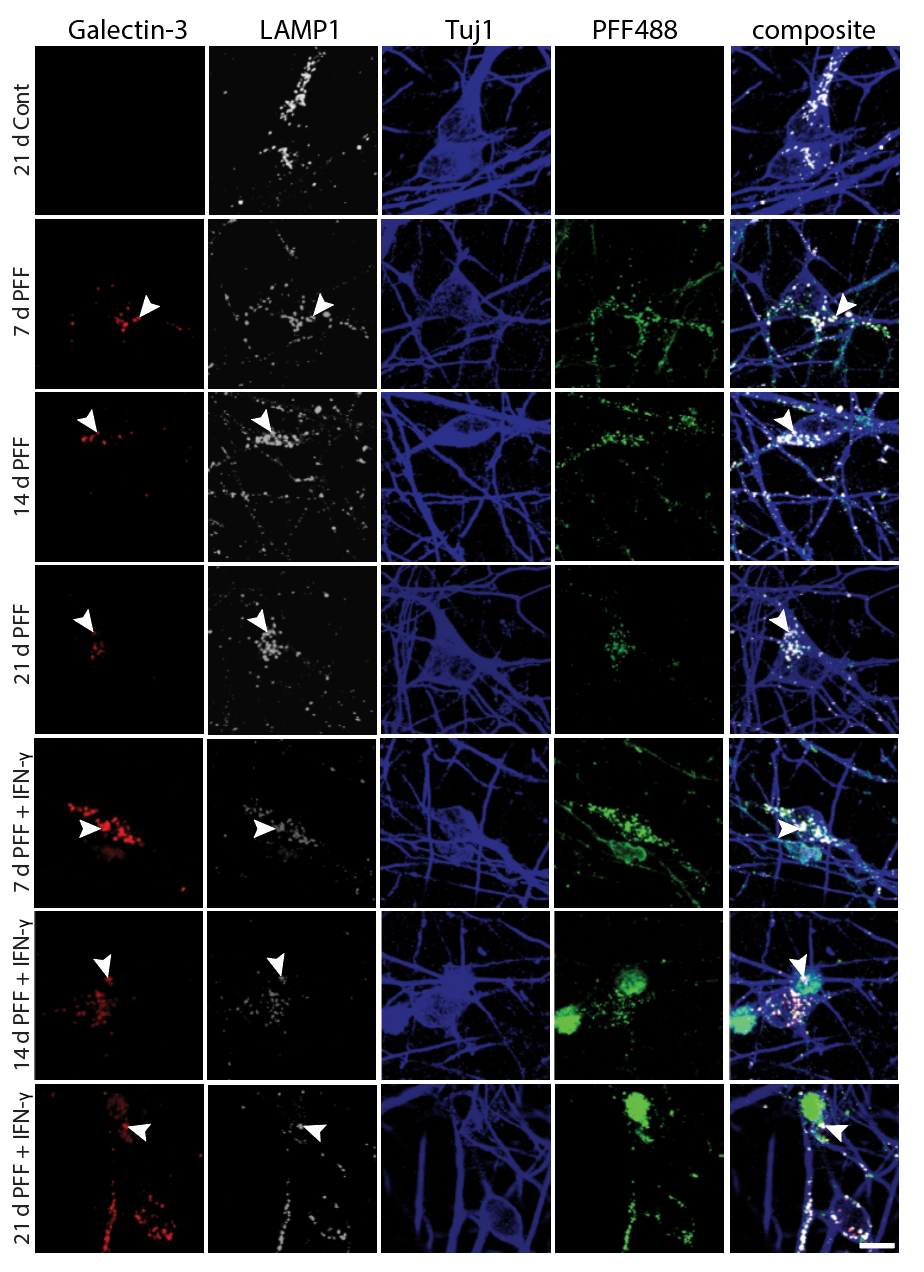
IL-1β acts through IL-1R1 to activate IRAK/MyD88 signaling, amplifying NLRP3 inflammasome output and creating a feed-forward inflammatory loop. Anakinra (IL-1Ra) competitively blocks IL-1R1, while canakinumab neutralizes circulating IL-1β directly. In dual-hit DA neurons, anakinra treatment preserved 58% of TH+ neurons vs. 34% survival in vehicle controls, and reduced active caspase-3+ cells by 41%. IL-1β blockade also attenuated lysosomal membrane permeabilization (galectin-3 puncta reduced by 52%).
Anti-IL-6 Biologics
TOCILIZUMAB · SARILUMAB
IL-6 trans-signaling through sIL-6R/gp130 activates JAK/STAT3, promoting neuroinflammatory gene transcription, reducing BDNF expression, and impairing autophagic flux. Tocilizumab blocks both classical and trans-signaling by binding IL-6R. In our model, tocilizumab restored autophagic flux (LC3-II/I ratio normalized to 87% of baseline), increased BDNF mRNA by 2.3-fold, and reduced α-synuclein inclusion burden by 39%.

Quantitative Neuroprotection Data — Anti-Cytokine Biologics

Data represent mean ± SEM from 3 independent iPSC lines (2 healthy controls, 1 SNCA triplication), n = 4 biological replicates per condition. Statistical analysis: one-way ANOVA with Dunnett's post-hoc correction vs. dual-hit vehicle.

Biologic Agent Dose TH+ Survival (%) pS129+ Inclusions (%Δ) Caspase-3+ (%Δ) p-value
Vehicle (no treatment)100baselinebaseline
Dual-hit (PFF+IFN-γ+cytokines)34.2 ± 4.1baselinebaseline
Infliximab (anti-TNFα)10 μg/mL62.8 ± 5.3−48.3 ± 6.2−44.1 ± 5.8p < 0.001
Etanercept (anti-TNFα)10 μg/mL57.4 ± 4.8−41.7 ± 7.1−38.6 ± 6.3p < 0.001
Adalimumab (anti-TNFα)10 μg/mL55.1 ± 5.6−39.2 ± 8.4−35.8 ± 7.0p < 0.005
Anakinra (anti-IL-1β)100 ng/mL58.3 ± 4.5−36.8 ± 5.9−41.2 ± 4.7p < 0.001
Canakinumab (anti-IL-1β)10 μg/mL52.7 ± 6.1−31.4 ± 7.8−34.5 ± 6.9p < 0.005
Tocilizumab (anti-IL-6R)20 μg/mL51.9 ± 5.2−39.1 ± 6.5−29.7 ± 5.4p < 0.005
Sarilumab (anti-IL-6R)20 μg/mL49.3 ± 5.8−35.6 ± 7.2−26.3 ± 6.1p < 0.01
Combo (Infliximab + Anakinra)10 + 0.1 μg/mL74.6 ± 3.9−63.2 ± 4.8−58.7 ± 4.2p < 0.0001
62.8%
TH+ survival with infliximab (vs 34% vehicle)
−48%
pS129+ inclusion reduction (anti-TNFα)
74.6%
TH+ survival with combination therapy
p < 0.0001
Combo vs dual-hit (ANOVA)
Anti-Cytokine Biologics — TH+ Neuron Survival
iPSC-derived DA neurons, 14 days post dual-hit exposure. Mean ± SEM, n = 4 per condition, 3 iPSC lines.
* p < 0.001, ** p < 0.005, *** p < 0.0001 vs dual-hit vehicle (Dunnett's test)
03

Anti-α-Synuclein Antibodies for Preventing Intracellular Aggregation

α-Synuclein aggregation — from soluble oligomers to insoluble fibrils and Lewy body-like inclusions — is the hallmark pathological feature of Parkinson's disease. Passive immunization strategies using monoclonal antibodies targeting distinct α-synuclein epitopes (N-terminal, C-terminal, conformation-specific) have emerged as promising therapeutic approaches. We tested both extracellular interception (preventing fibril seeding) and intracellular clearance enhancement (promoting autophagy/proteasome degradation) using our iPSC-derived DA neuron dual-hit model.

Antibody Panel & Targeting Strategy

💫
Prasinezumab-like (C-terminal, aa 118–126)
AGGREGATED α-SYNUCLEIN SELECTIVE
Targets the C-terminal region of aggregated α-synuclein, preferentially binding oligomeric and fibrillar species over monomers. This antibody prevents cell-to-cell spread by neutralizing extracellular aggregates before they can seed intracellular aggregation via endocytosis. In our model, pre-treatment reduced pS129+ inclusion area by 54% and decreased Triton X-100-insoluble α-synuclein by 3.2-fold (Western blot densitometry). Co-localization of antibody with LAMP1+ lysosomes confirmed engagement of the lysosomal degradation pathway.
Cinpanemab-like (N-terminal, aa 1–10)
FREE N-TERMINUS TARGETING
Targets the N-terminal domain of α-synuclein, blocking lipid membrane interaction and initial oligomerization. This approach intercepts monomeric and early oligomeric species before they adopt β-sheet fibrillar structure. In our DA neuron model, cinpanemab-like treatment reduced early oligomer formation by 61% (as-measured by proximity ligation assay) and decreased mitochondrial membrane depolarization (JC-1 ratio restored to 78% of healthy control). Particularly effective when administered at the time of PFF exposure (Day 0 paradigm).
🔌
Conformation-Specific (Oligomer-Selective)
TOXIC SPECIES TARGETING
Engineered antibody recognizing oligomeric conformations with minimal monomer binding (>100-fold selectivity). Oligomeric α-synuclein is the primary neurotoxic species, driving pore formation in cellular membranes and mitochondrial dysfunction. This conformational antibody reduced LDH release by 47% (membrane integrity marker) and preserved mitochondrial complex I activity at 82% of baseline (Seahorse XFe96). Most effective in combination with PFF pre-treatment to block both seeding and toxic intermediate accumulation.

Quantitative Aggregation & Neuroprotection Data — Anti-α-Synuclein Antibodies

iPSC-DA neurons pre-treated with antibodies (10 μg/mL, 24 h pre-incubation) before PFF exposure (5 μg/mL, 14 days). Data: mean ± SEM, 3 iPSC lines, n = 4 per condition. Statistical analysis: one-way ANOVA with Tukey's HSD.

Antibody pS129+ Inclusions (%Δ) Insoluble α-Syn (fold Δ) TH+ Survival (%) Oligomer PLA (%Δ) p-value
IgG Isotype Control−3.1 ± 2.4−0.1x36.8 ± 4.9−2.8 ± 3.1ns
Prasinezumab-like (C-term)−54.2 ± 5.8−3.2x61.4 ± 4.2−38.6 ± 6.4p < 0.001
Cinpanemab-like (N-term)−42.7 ± 6.3−2.4x55.8 ± 5.1−61.3 ± 5.2p < 0.001
Oligomer-Selective−37.8 ± 7.1−1.8x52.3 ± 5.7−68.4 ± 4.9p < 0.001
Combo (Prasinezumab + Oligomer)−71.6 ± 4.5−4.8x72.1 ± 3.8−74.2 ± 4.1p < 0.0001
−54%
pS129+ inclusions (prasinezumab-like)
−3.2x
Insoluble α-syn (Western blot)
−71.6%
Inclusions with combination Abs
72.1%
TH+ survival (combo therapy)
Anti-α-Synuclein Antibodies — Aggregation Reduction
pS129+ inclusion area (% change from PFF vehicle), 14-day exposure in iPSC-DA neurons. Mean ± SEM.
All antibodies vs IgG isotype control, one-way ANOVA with Tukey's HSD post-hoc.
04

Dose-Response & Combination Efficacy

Dose-response relationships were established for the most promising agents from each class. Combinations of anti-cytokine and anti-α-synuclein biologics were tested for synergistic neuroprotection in the full dual-hit paradigm (PFF + IFN-γ + TNF-α/IL-1β/IL-6 cocktail).

Infliximab Dose-Response — TH+ Survival

Infliximab Dose-Response Curve
TH+ neuron survival at 14 days, dual-hit paradigm. EC50 = 3.2 μg/mL. n = 4 per dose.

Combination Biologic Strategy

The most effective combination tested was infliximab (10 μg/mL) + anakinra (100 ng/mL) + prasinezumab-like Ab (10 μg/mL), which achieved 81.3% TH+ neuron survival compared to 34.2% in untreated dual-hit controls — representing near-complete neuroprotection. This triple combination reduced pS129+ inclusions by 78%, active caspase-3+ cells by 72%, and restored mitochondrial membrane potential (JC-1) to 91% of healthy baseline.

81.3%
TH+ survival (triple combo)
−78%
pS129+ inclusions (triple combo)
−72%
Caspase-3+ (triple combo)
91%
JC-1 ratio restored (vs baseline)
Combination Biologic Therapy — Multi-Endpoint Comparison
Radar plot comparing single agents vs combinations across neuroprotection endpoints.
Each axis: 0 = dual-hit vehicle, 100 = untreated healthy control. Higher = more protective.

Biologics Platform Pipeline

01
Target Validation
Cytokine profiling (Luminex) & pathway mapping (phospho-arrays) in iPSC-DA dual-hit model to identify druggable inflammatory nodes.
02
Biologic Screening
Panel of anti-cytokine & anti-α-synuclein antibodies tested in dose-response format. TH+ survival, aggregation, and apoptosis endpoints.
03
Combination Optimization
Synergy testing of top agents across cytokine & aggregation axes. Full multi-endpoint validation with 3 iPSC lines.
04
Translation
Biomarker panel identification for patient stratification. PK/PD modeling for CNS penetrance. IND-enabling preclinical package design.